01
Protects foundations
By relieving water pressure near the home, a French drain can help reduce moisture intrusion and the long-term stress that repeated saturation places on foundation walls.
Understand how French drains work, when you need one, what installation involves, how much it may cost, and what to ask before hiring a contractor. This page is designed to educate visitors and convert them into qualified leads.
A French drain is a gravel-filled trench with a perforated pipe designed to collect and redirect groundwater or surface water away from vulnerable parts of a property. It is commonly used to reduce soggy lawns, hydrostatic pressure near foundations, damp basements, and erosion around hardscapes.
By relieving water pressure near the home, a French drain can help reduce moisture intrusion and the long-term stress that repeated saturation places on foundation walls.
It channels water away from low spots so lawns and planting beds dry out faster after storms, making outdoor spaces safer and more usable.
When runoff is directed intentionally, soil washout around landscaping, retaining walls, patios, and walkways can be minimized.
The exact approach changes with slope, soil type, proximity to structures, depth requirements, and outlet options, but the general sequence below covers a standard installation path.
Identify where water originates, where it collects, and where it can discharge safely.
Dig the trench to the required depth and maintain a consistent slope toward the outlet.
Line the trench with filter fabric and add a stone base to support the perforated pipe.
Install perforated pipe, connect any tie-ins, and verify pitch before covering.
Wrap fabric, add aggregate, restore the surface, and test water flow to the outlet.
Use this quick calculator to estimate a probable project range. This is an educational planning tool, not a formal quote.
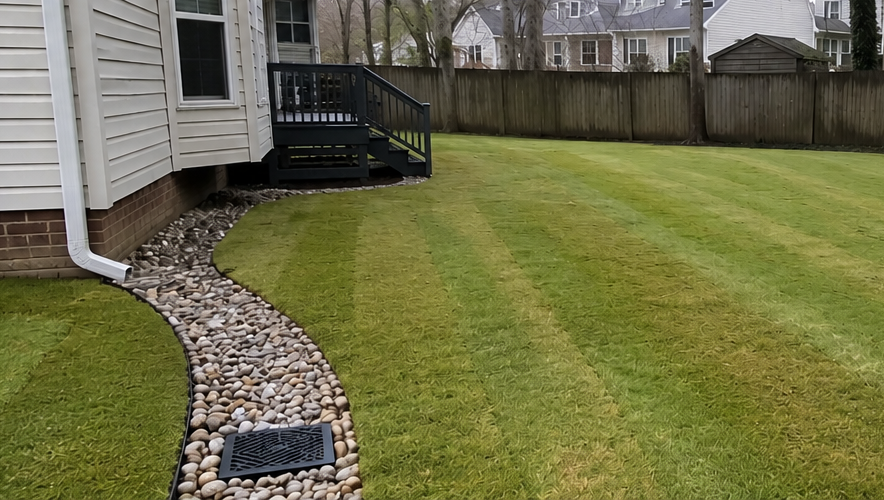
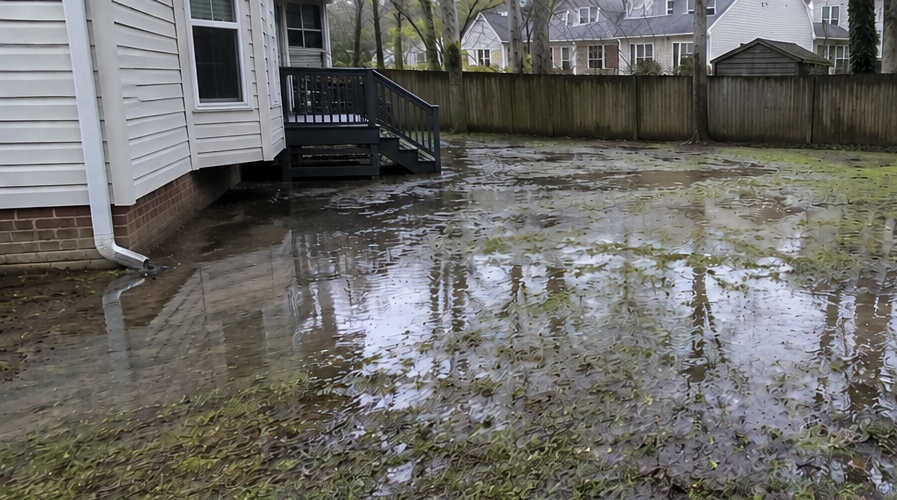
Use the slider to compare a waterlogged yard to a graded and drained result.
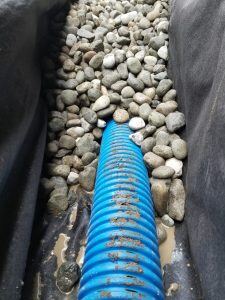 Trench & Pipe Layout
 Finished Surface Restoration
Clear answers help homeowners make better decisions before committing to a drainage project.
Depth depends on the problem being solved. Yard drains are often shallower than foundation drains, while deeper systems may be necessary when you need to intercept water before it reaches a basement or retaining structure.
Many installers use perforated corrugated pipe or PVC, depending on design preferences, clean-out requirements, depth, and expected traffic over the drain path.
Yes—downspouts are often tied into a drainage plan, but the exact configuration should ensure the system has enough capacity and a safe discharge point.
Time varies with length, depth, machine access, and restoration needs. Short, accessible yard systems are usually quicker than deeper perimeter or waterproofing-related installations.
They should be inspected periodically for clogs at inlets, catch basins, and discharge points. Keeping leaf debris, roof granules, and sediment out of the system helps extend performance.
We serve Pensacola and surrounding areas